The morphological transitions of historic districts is not a mere physical reconstruction process, but a generative structure in which institutional logic, social behavior and spatial use are continuously nested and negotiated in a multi-scale network.This study focuses on the key issue between “how morphology evolves” and “how evolution is socialized”, and proposes a new research paradigm that integrates graph theoretic modeling, morphological analysis and socio-spatial interpretation, and systematically constructs a cross-scale modeling and mechanism of urban morphology using topological network as the carrier and structural evolution as the main line.We propose a new research paradigm that integrates graph theoretic modeling and socio-spatial interpretation, using topological network as the carrier and structural evolution as the main line, and systematically constructing an analytical framework for cross-scale modeling of urban morphology and mechanism identification.
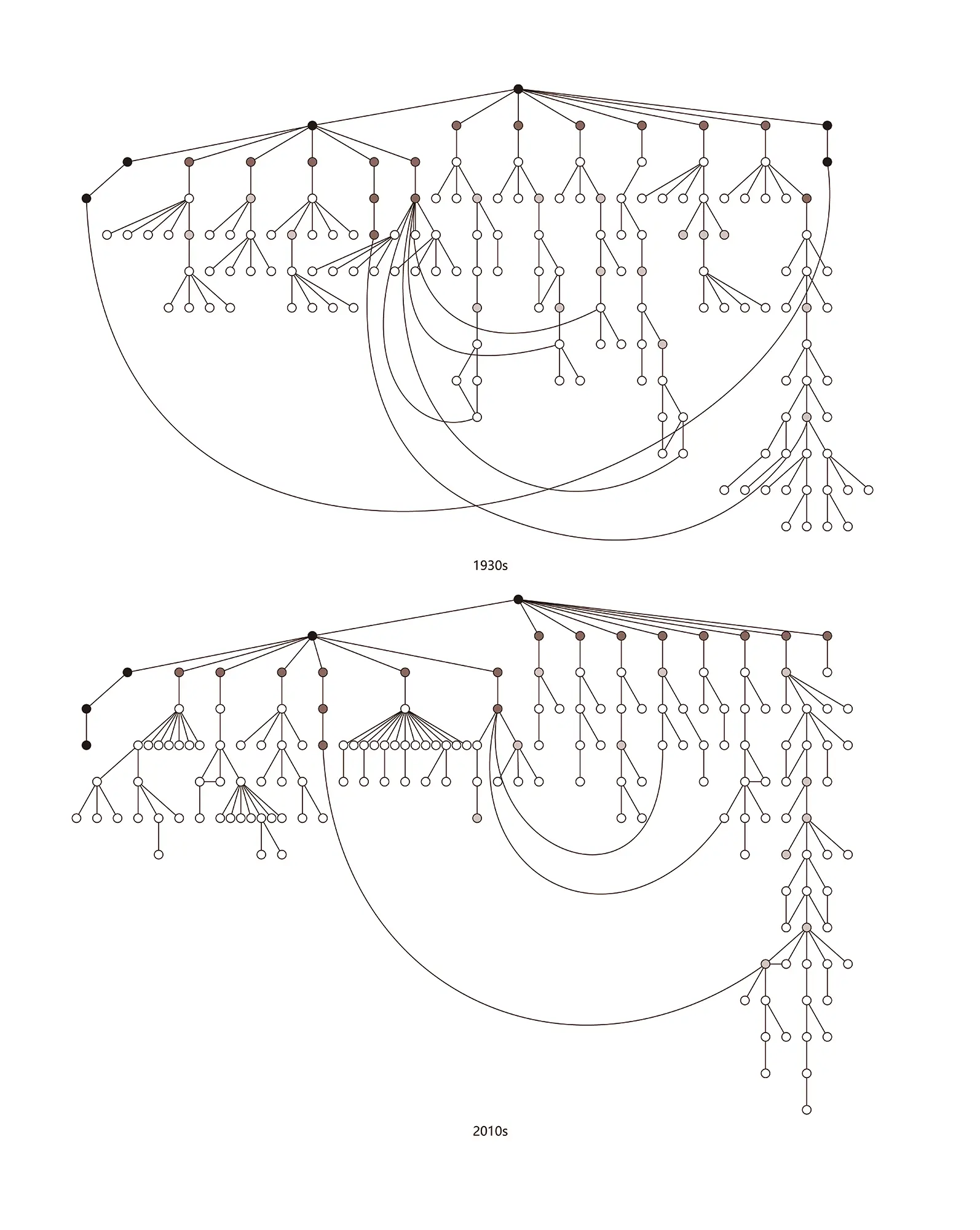
Specifically, this paper takes Nanjing Xiaoxihu Historic Block as the core case and proposes the Cross-Scale Topological Network Model to construct a multi-level spatial structure covering street nodes, front-door spaces, courtyard nodes and functional room nodes.System.Through historical data analysis and field reconstruction, we recovered six morphological stages of six representative plots (Plots 1-6) of Xiaoxihu from 1930s to 2010s, and accordingly drew cross-scale network topology maps and J-Graph maps to quantify their structural depth, node coupling relationships and link path changes.
Based on this, this paper proposes Structure Evolution Degree (SED), which measures the evolution of the network in time series from three dimensions: node type variation, path depth perturbation and spatial function reorganization.Instead of relying on the field-of-view analysis, SED is based on the graph structural features to capture the “structural tension” of the urban evolution process.Instead of relying on visual field analysis, SED is based on graph structural features to capture the “structural tension” and “systematic rupture” in the urban evolution process.
In order to further explain the social mechanism behind the spatial evolution, this paper introduces the Multi-layered Graph Framework, which constructs a triangular structural model consisting of Urban Morphology Layer, Interaction Layer and Social Behavior Layer, and identifies the social mechanisms behind the spatial evolution.We introduce the Multi-layered Graph Framework to construct a triangular structural model consisting of “Urban Morphology Layer”, “Interaction Layer”, and “Social Behavior Layer”, to identify the “Key Subgraphs” generated by the social forces embedded in the spatial structure, and to systematically develop the analysis of the “Urban Morphology Layer” and the “Social Behavior Layer”. The study identifies the “Key Subgraphs” generated by the embedding of social forces in the spatial structure, and systematically develops a social mapping explanation of “how space changes”.
On the theoretical level, the study integrates Lefebvre’s theory of “spatial production”, Bourdieu’s theory of “Habitus and field” and Foucault’s “spatial mechanism of power” to construct a graph structure to explain the encoding paths of institutional regulation, residents’ habitus and community negotiation in the nodal space.The mechanism analysis of Plot 3 and Plot 5 shows that the spatial reconstruction process of Xiaoxihu presents a hybrid system of mechanisms consisting of Permanence, Variation and Permutation, and its evolution is not linear, but rather consists of multiple social mechanisms focusing on the space in front of the door, the space in front of the door, the space in front of the door, the space in front of the door, the space in front of the door, the space in front of the door, the space in front of the door, the space in front of the door, the space in front of the door, the space in front of the door, the space in front of the door and the space in front of the door.social mechanisms focused on nodes such as front-door space, courtyard junction, and functional room paths, forming structural responses in the topological map.
At the methodological level, this study bridges the path break between typological and structuralist approaches, and proposes a graph structural system that can be used for spatial transformation analysis, social mechanism identification and design strategy prediction, which serves both micro-node analysis and has the potential to be translated to machine learning (e.g., graph neural network) models.
At the empirical level, the study reconstructs the topological mapping of Xiaoxihu Block at six stages, and analyzes the SED trend, P/V/P type and key sub-maps of typical plots against each other to reveal the topological responses of residents’ behavior, property rights transfer and institutional intervention in the spatial structure, providing concrete paths to understand how the “Reality” is generated and identified in the spatial hierarchy.This provides a concrete path for understanding how “social reality” is generated and recognized in the spatial hierarchy.
In summary, the methodology system of “cross-scale graph structure + social mechanism modeling” proposed in this paper not only expands the toolbox of urban morphology research, but also provides the theoretical foundation and technical framework for the identification of spatial strategies and expression of negotiation mechanisms in the future scenarios of community governance, urban regeneration, participatory design, and morphology intelligent generation.