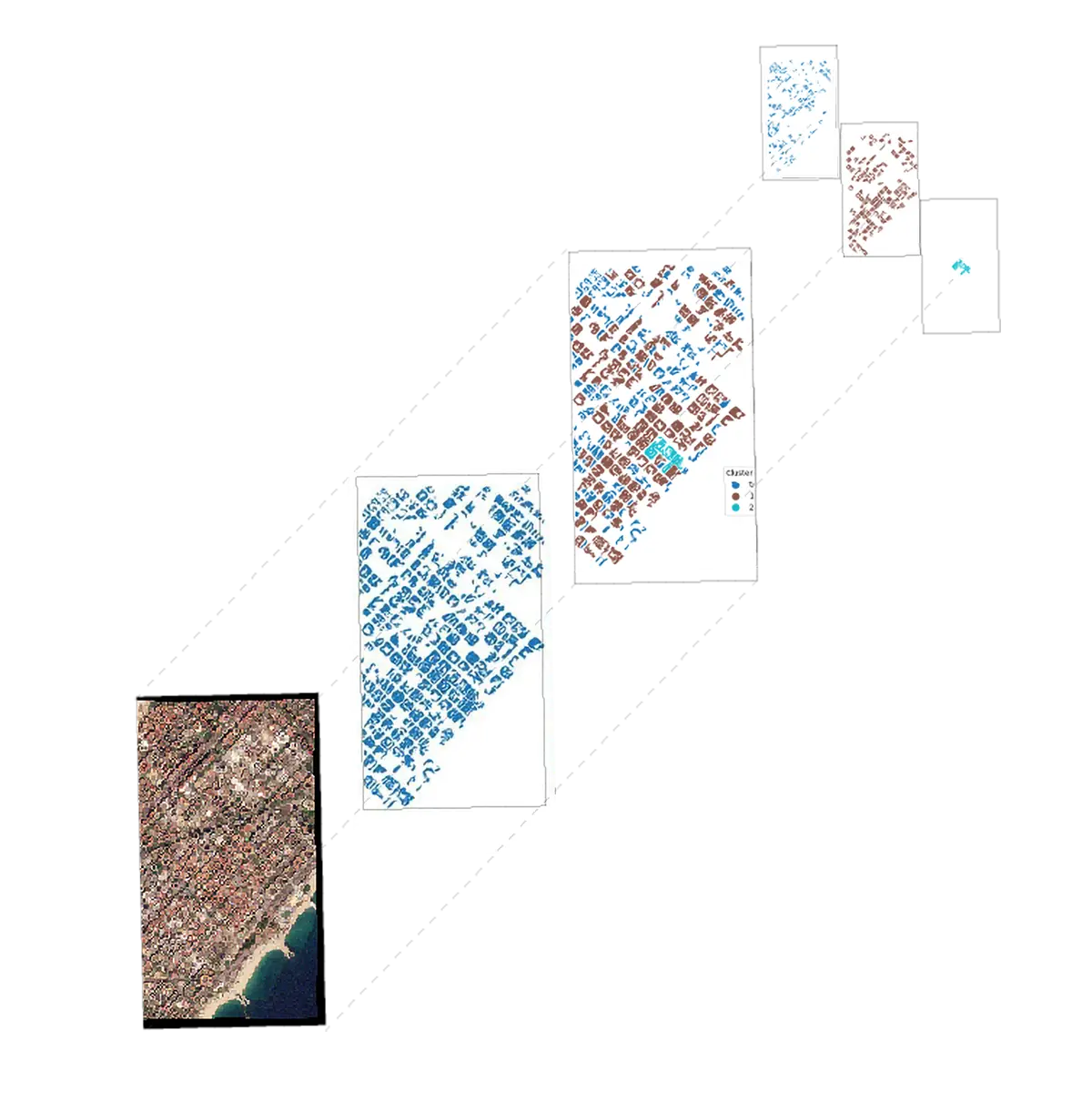
This research stems from two important considerations on the evolution of architecture and design. First, recent years have seen increasing interest in studying the urban form, due to the wider accessibility to geographic data and mapping tools. Second, the latest advancements in machine learning have provided researchers with a range of innovative tools. In light of these developments, this study aims to establish a comprehensive, systematic methodology for identifying and analyzing urban form through the application of machine learning techniques.
The emergence of urban morphology as a distinct strand within architectural literature, focusing on core components like streets, buildings, and blocks, sets the context for this study. Among these elements, urban blocks hold a pivotal role due to their central position and interactions with other components. This research concentrates on urban blocks, specifically focusing on their detection and classification using machine learning techniques. It delves into the interplay between urban morphology and advancements in artificial intelligence (AI), aiming to integrate these fields to gain deeper insights into urban form elements.
In addition to the introductory chapter, this study is organized into three distinct parts, each with a specific focus and set of objectives. The first part is devoted to developing a theoretical framework on the mapping of urban morphology in relation to AI applications, emphasizing the contemporary shift towards quantitative and data-driven approaches in analyzing urban form. This part delves into the quantification of urban form, the role of data-driven studies in urban analysis, and the critical impact of AI and remote sensing technologies in this field. It also presents a comprehensive review of various definitions found in the literature and introduces a novel, systematic approach for defining this concept. This part comprehends chapters 1 and 2.
The second part, representing the core of the thesis, centers on the model application, offering a detailed workflow, analytical framework, and insights into the extraction process, delving into the detailed application of a model incorporating deep learning on exemplifying on urban block detection and classification. This part comprehends chapter 3.
The final part focuses on the practical application of the method developed in this study. It delves into the urban block classification, analyzing the results derived from applying the model in different cities. This section examines the use of predefined metrics, conducts comparative analyses of clusters both within and across cities, and extends into the taxonomic comparison of two approaches, the conventional method, where blocks are defined based on their constituent elements (streets, plots, buildings) and classified based on their shape and size and the AI-driven approach. Additionally, it includes a thorough discussion on the feasibility and implications of this approach, thereby offering valuable insights into the future intersection of urban morphology and machine learning. This part comprehends chapters 4 and 5.
This research leverages high-resolution satellite imagery, capturing an extensive and diverse spectrum of urban forms from cities across Europe, America, and Asia. These images are accurately labeled to create a training dataset, an indispensable element in machine learning applications. In fact, the premise of supervised machine learning lies in training a model on a subset of data for which the variables of interest, those to be predicted, are known. In this study, the training dataset comprises a large collection of urban form images, with the urban block, the primary variable of interest, explicitly identified and marked by the researcher. Once the model ‘learns’ from this set of data, it can be used to make predictions on the presence or absence of urban blocks in previously unseen data, where the variable of interest is initially unknown.
The outcomes of this study delineate a comprehensive path for urban researchers to detect and classify urban forms. The results include the development of a taxonomy and a detailed analysis of its indicators, grounded in relevant literature. Beyond its conceptual contributions, the preliminary findings offer a glimpse into the outcomes of training and the evaluation of the supervised machine learning model utilized for the prediction and classification of urban blocks. This research marks a significant advancement in the integration of AI and machine learning techniques with urban morphology practices, laying the groundwork for a novel trajectory in future studies at this intersection. The study not only contributes to theoretical frameworks but also provides practical insights, exemplifying the potential of advanced technologies in reshaping urban research methodologies.