The urban areas of Northern Italy have experienced critical transformations in their socio-economic structure in recent decades and have seen universities become key players, acting as magnets for both economic investment and the non-resident students. Cities that are strengthening their role as centres of higher education experience transformation processes that challenge their societies, environments and economies, for which the sustainability of their development and the well-being of their citizens are at stake. In urban studies, some of these changes have been approached through the lens of the relationship between universities and cities (the ‘town & gown’ debate), which has led to a focus on two main areas of enquiry. The first emphasised the importance of universities as growth assets in the context of the knowledge-based economy, for which student mobility is at the heart of cities’ attraction strategies. The second addressed the positive and negative externalities induced by the attraction of a student population. On the one hand, students in cities are agents of socio-economic regeneration and contribute to urban vibrancy. On the other, studies on ‘studentification’ highlight a specific process of gentrification of neighbourhoods induced by the growing presence of students, in which social cohesion and neighbourhood liveability falter.
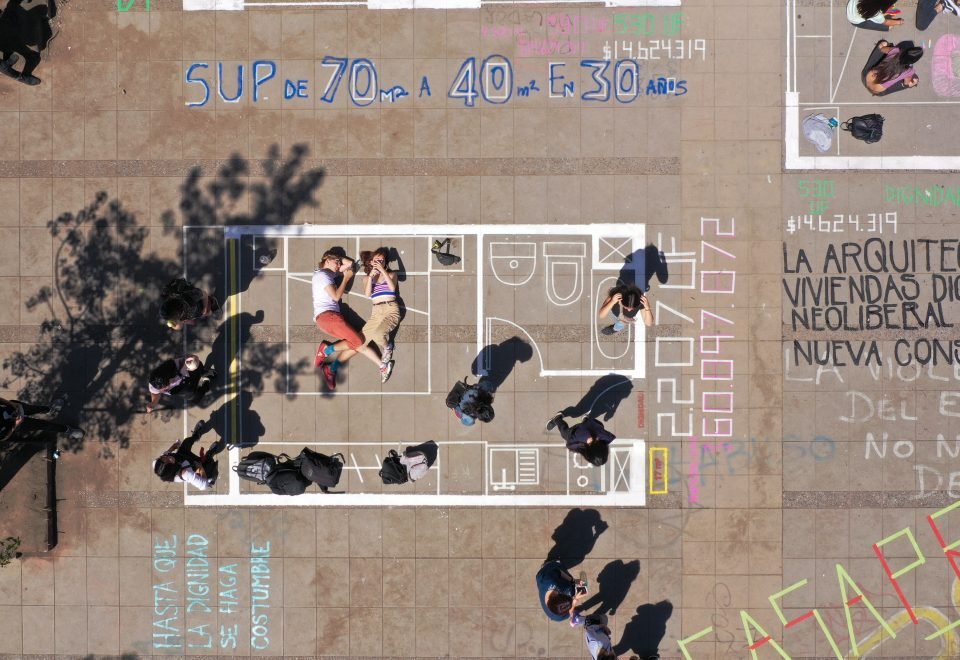
Within this framework, the student housing sector must be highlighted as a crucial aspect, especially for its implications and challenges to social sustainability. Firstly, students’ struggles to access adequate and affordable housing have an impact on students’ living and personal conditions. Secondly, the struggle for housing is mirrored by the conflicts and demands of the most deprived part of the local population, especially in cities and neighbourhoods where there is a shortage of housing supply and an increasing demand for non-permanent uses (e.g. tourism). Third, the combination of real estate and urban dynamics has favoured the transformation of student housing into financial assets.
The student population in Italy is about 1,793,000, while the student housing system offers only 42,732 places (MUR). While the PNRR aims to increase supply, the dynamics induced by the growing presence of students and related investments are putting the welfare of students and residents at stake. The transformations of Italian university towns can only be framed in part in the existing town & gown literature. New perspectives from Southern Europe, which locate urban changes in the reciprocal relationship between university, students and city, constitute an important advancement of knowledge in the debate, raising attention to a vital issue for most European cities.
Ongoing research
The strand of research on the complex relationship between university and city began in 2020 with the H2020 SMARTDEST project, in which part of the activities made it possible to analyse the forms of social exclusion connected to university student mobility in some areas of the city of Turin; among the outputs was the publication of the Quaderno FULL “Torino da fuori”. Subsequently, this strand is developed within FULL through the implementation of two complementary projects running in parallel over the two-year period between the academic years 2023/2024 and 2025/2026. Both projects follow a multidisciplinary approach and involve research teams with members from inside and outside FULL, with expertise in the areas of urban planning and urban studies, geography and sociology.
OSA
The two-year project OSA – Ossevatorio Student* and Abitare, which started in July 2023, funded by the DIST department and in which FULL is an operating partner and member of the coordination committee. Other strategic partners of the project are the City of Turin and IRES Piemonte (Institute of Economic and Social Research).
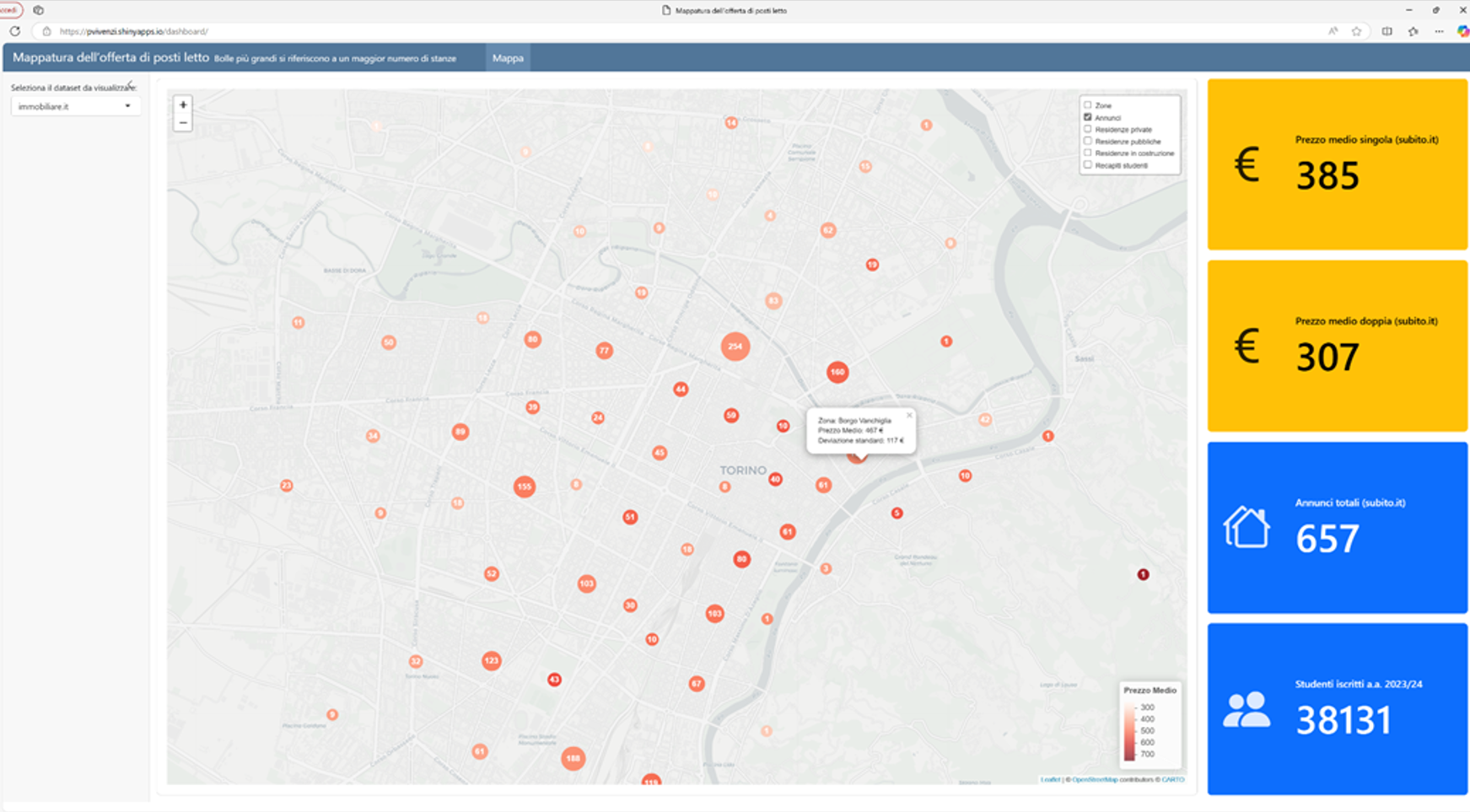
OSA aims to set up an observatory on the characteristics of the university student population and its relationship with the city of Turin, in particular with regard to the housing issue relating to the non-local component (students away from home). It is a necessary tool to know the consistency and characteristics of this population, such as the contexts of origin, where they live in Turin and the interactions with public and private actors, with the third sector and the territorial transformation strategies implemented by the administrations concerned.
The observatory has the following practical objectives
- Building a database on the student population, particularly off-site, with attention to composition (origin, age, gender…) and location on the territory;
- Investigation of key issues relating to the right to study: heterogeneous composition of needs, access to services and housing, trends in housing supply and demand, forms of discrimination, especially for foreign students or students from at-risk backgrounds, forms of social and civic mobilisation;
- Coordination of active players in the university and student system, with a view to concerted decision-making processes;
- Compilation and publication of data and analyses to support decision-making processes and initiatives (1) within the public administration, (2) within organisations providing services to students and promoting the right to education, and (3) amongst the student population itself.
The OSA project and observatory page can be found here.
LINUS
The two-year project ‘LINUS – Living the university city. Student housing as drivers of changes’, which started in November 2023, is one of the PRIN 2022 PNRR projects funded by the Ministry of University and Research and of which the Turin unit, coordinated by Loris Servillo, is Principal Investigator. The other Research Units involved belong to the State University of Milan Bicocca, the University of Bologna and the University of Padua.
The research project LINUS – LIviNg the UniverSity city, addresses the dynamics of student housing as a driver of urban change and as a challenge to sustainability in cities, where university attraction policies and the related growth of the student population in the city stress the wider housing supply. The project belongs to the Emerging Topic of the Call “human well-being”, in Cluster 2, and develops its research agenda in topic 6, for which social sustainability and its drivers are at stake. The LINUS research agenda investigates the student housing dynamics (SHD) in four cities (Bologna, Milan, Padua, Turin) characterised by the increasing presence of students, and by the difficulties in finding adequate housing conditions for both students and residents, due to the shortage or competition of supply, which are reaching critical levels.
Under Theme 6, therefore, the LINUS research question is about understanding how the role of universities and their attractiveness to non-resident students generate SHDs that are (a) drivers of urban change, (b) disruptive factors in the wider housing sector and (c) causes of exclusionary processes, which undermine urban social sustainability. Consequently, it examines how universities should operate in a socially responsible manner regarding SHDs and promote social inclusion for all citizens, whether they are part of a permanent or mobile population.
The objectives of the research are:
- To fill the knowledge gap on students’ housing conditions, careers and trajectories.
- Unravel the structure and dynamics of SH provision (including changes in the actors involved and the influence of local, regional and national policies).
- Understand the interrelation between SHD and the general dynamics of the housing market.
- Extend the project results, reflections and analytical model to city contexts and neighbourhoods affected by similar disruptive urban changes.